
Listen to this article
Audio version available
As a business owner, you're expected to maintain an active social media presence, send regular email campaigns, create engaging content, and analyze marketing performance, all while actually running your business. You watch competitors with full marketing departments dominate your industry while you're up late writing social media posts or spending your weekends trying to design graphics. Artificial intelligence has leveled the playing field, giving solo entrepreneurs and small business owners access to marketing capabilities that previously required entire teams and substantial budgets. Picture automating your social media schedule for an entire month in one afternoon, creating professional product videos from photos you already have, or getting detailed analytics insights without spending hours in spreadsheets. This guide reveals which AI marketing tools actually deliver results for busy business owners and how to implement them without becoming a technology expert.
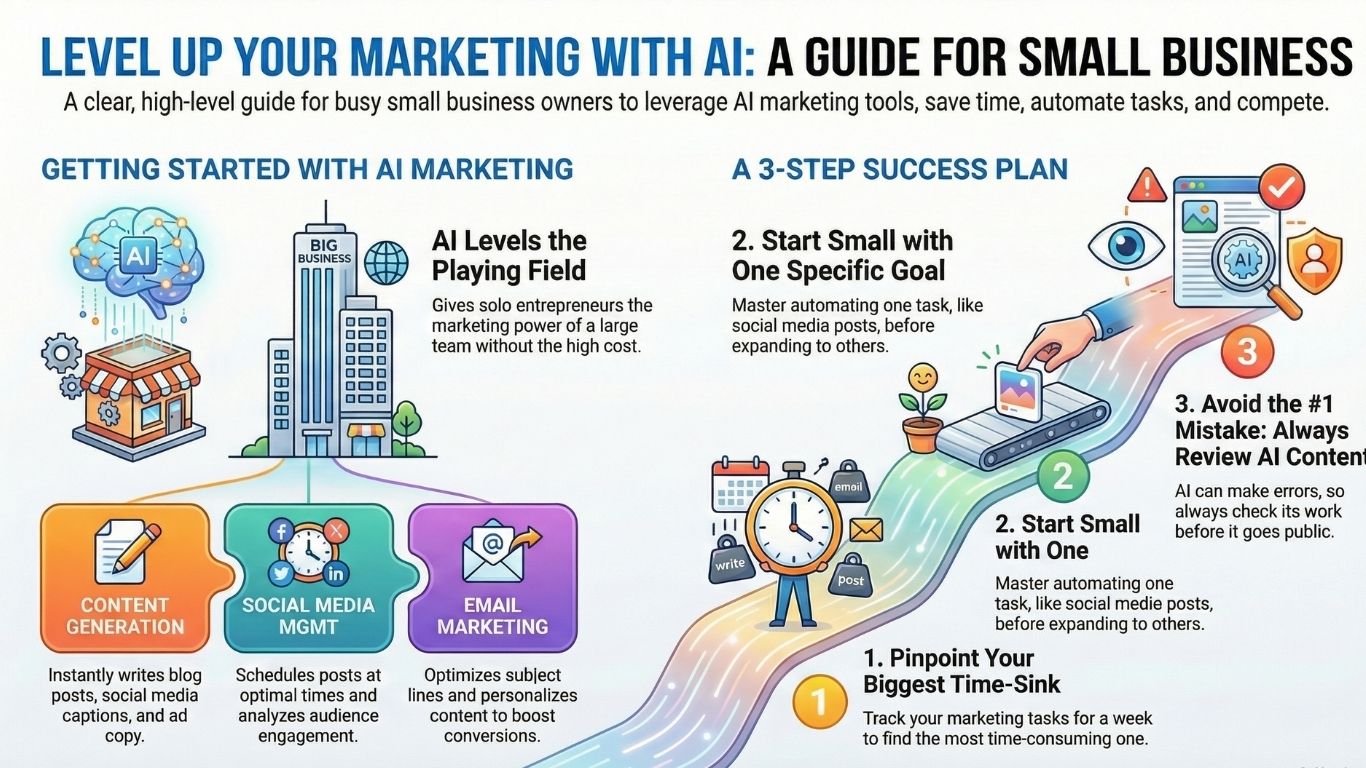
Table of Contents
- Understanding AI Marketing Tools
- Essential Categories of Marketing AI
- Choosing the Right Tools for Your Needs
- Implementing AI Tools Successfully
- Maximizing ROI from Marketing AI
- Integration and Workflow Optimization
- Common Implementation Mistakes
- Future-Proofing Your Marketing Stack
- Build Your Marketing with ArtFly AI
Understanding AI Marketing Tools
AI marketing tools leverage machine learning, natural language processing, and predictive analytics to automate and enhance various marketing activities that traditionally required significant manual effort. Consider Sarah, a boutique clothing store owner who used to spend three hours every Sunday creating social media posts for the week ahead, now she uses AI tools to generate a month of content in under an hour. These platforms go beyond simple automation by actually learning from data patterns to make intelligent decisions about content, timing, targeting, and messaging based on what works for your specific audience. The technology can analyze millions of data points across customer interactions, campaign performance, and market trends to identify opportunities and optimize strategies in real-time. Modern marketing AI tools range from specialized point solutions that excel at specific tasks to comprehensive platforms that attempt to handle multiple marketing functions, giving you the flexibility to start small and expand as needed.
Essential Categories of Marketing AI
Content generation tools use large language models to produce written materials like blog posts, social media captions, email copy, and ad text based on prompts describing your goals and target audience. A local restaurant owner used visual creation platforms to transform simple food photos into professional menu designs and promotional videos without hiring a graphic designer. Social media management systems use AI to schedule posts at optimal times, suggest content ideas, respond to comments, and analyze engagement patterns across multiple platforms simultaneously, perfect for business owners managing Facebook, Instagram, and LinkedIn alone. Email marketing tools leverage AI for subject line optimization, send-time prediction, content personalization, and automated segmentation based on recipient behavior, turning your customer list into targeted campaigns that actually convert. Analytics and insights platforms process vast amounts of data to identify trends, predict outcomes, attribute conversions accurately, and recommend strategic adjustments, giving you the marketing intelligence that enterprise competitors pay consultants thousands to obtain.
Choosing the Right Tools for Your Needs
Start by tracking where you spend your marketing time for one week to identify which tasks consume the most hours or cause the most stress, whether that's writing social posts, designing graphics, or analyzing campaign results. For example, if you're spending ten hours weekly on social media content, an AI content tool could be worth the investment even at premium pricing. Evaluate tools based on how well they integrate with platforms you already use like your website, email system, or e-commerce store, as seamless integration means you'll actually use the tool instead of it becoming shelfware. Consider your technical comfort level honestly, as some AI tools require significant setup while others work immediately, and you need solutions you can implement yourself without hiring consultants. Request free trials to test tools with your actual business data before committing, because a tool that works brilliantly for a restaurant might be completely wrong for a consulting business.
Implementing AI Tools Successfully
Begin with one specific marketing pain point rather than trying to transform your entire marketing operation overnight, such as using AI just for social media posts or just for email subject lines. A fitness studio owner started by using AI to generate weekly class descriptions and social posts, mastered that workflow, then expanded to email campaigns and promotional videos over the following months. Set a clear goal before starting, like reducing social media time from five hours to two hours weekly, so you know whether the investment is working. Start by reviewing every AI-generated output yourself before it goes public, gradually trusting the system more as you learn its strengths and limitations through real use. Keep a simple document of prompts that work well for your business, saving examples like "create an Instagram caption for [product] targeting [audience]" that you can reuse and refine.

Maximizing ROI from Marketing AI
Focus your AI tools on activities that directly generate revenue, like creating product videos that drive purchases or optimizing email subject lines that increase open rates and sales. A handmade jewelry business owner tracked that AI-generated product descriptions increased conversion rates by fifteen percent, generating thousands in additional revenue that far exceeded the tool's monthly cost. Calculate your time savings in dollar terms by determining what an hour of your time is worth to your business, then multiply that by the hours AI saves you weekly. Monitor whether AI-generated content actually performs well by checking engagement rates, click-through rates, and conversions, not just whether it saves you time. Continuously test new AI features as they roll out, because the tool you signed up for six months ago likely has powerful new capabilities you haven't discovered yet.
Integration and Workflow Optimization
Connect your AI tools to platforms you use daily so content flows automatically instead of requiring manual copying and pasting between systems. An online coach set up her AI writing tool to draft blog posts, automatically send them to her website, and generate social media versions that post directly to Facebook and LinkedIn without touching each platform separately. Create simple templates for recurring content needs, like product launch announcements or weekly newsletters, where you just fill in the specific details and AI handles the formatting and distribution. Set calendar reminders to review your AI tool usage monthly, checking whether you're actually using features you're paying for or if you could switch to a cheaper plan. Start a simple spreadsheet tracking which marketing activities use AI and which are still manual, helping you identify the next opportunity to automate and save time.

Common Implementation Mistakes
Many business owners subscribe to AI tools after watching impressive demos, then never actually use them because they didn't schedule time to learn the system or integrate it into their daily routine. A common mistake is publishing AI-generated content without reviewing it first, like the bakery owner who posted an AI-written Instagram caption that mentioned products she didn't actually sell. Expecting AI to understand your business immediately leads to disappointment, when the reality is you need to train the system through feedback and refined prompts over several weeks to get consistently good results. Buying multiple AI tools that do similar things wastes money, like paying for three different social media AI platforms when one properly configured tool would handle all your needs. Forgetting to check your AI outputs for accuracy causes problems, as these tools occasionally generate plausible-sounding information that's completely wrong, potentially damaging your credibility with customers who notice the errors.
Future Proofing Your Marketing Stack
Choose AI tools from established companies or well-funded startups that regularly release new features, avoiding platforms that haven't updated in months as they may not survive in this rapidly evolving market. A consulting firm owner learned this lesson when her chosen AI tool shut down after six months, forcing her to migrate all her content and workflows to a new platform. Look for tools that connect easily with other software through integrations or APIs, so you're not trapped if you need to switch providers or add new capabilities. Invest time learning how to write better prompts and understand AI basics through free YouTube tutorials or courses, making you less dependent on any single vendor's interface or approach. Join online communities of other business owners using AI marketing tools, like Facebook groups or LinkedIn communities, where people share real experiences, recommendations, and warnings about what works and what doesn't.

Build Your Marketing with ArtFly AI
ArtFly AI provides a comprehensive platform for creating the visual and video marketing assets that drive engagement across all your campaigns and channels. Generate custom product images, social media graphics, and advertising visuals using AI image creation, then enhance them with background changes, object additions, or other modifications to match your brand guidelines. Transform static marketing images into dynamic video content by adding camera movements, transitions, and professional AI-generated voiceovers that bring your message to life. Create complete video marketing campaigns by developing multiple scenes with different messaging, then sequencing them into cohesive narratives that guide viewers through your story. With integrated music generation for setting the right mood and automatic subtitle creation for accessibility and silent viewing, you can produce professional marketing videos that capture attention and drive conversions without expensive production teams or complex software.
Watch Video Tutorial
Related Articles

The Best AI Tools for Marketing to Boost Your 2026 Campaigns
Discover the top AI tools for marketing that streamline content creation, automation, and strategy. Learn how to boost ROI today.
9 min read
Digital Marketing AI: The Secret Engine for Business Growth
Discover how digital marketing AI transforms business growth with predictive analytics and personalized customer experiences.
7 min read
AI Marketing Tools: Revolutionize Your Strategy in 2026
Discover how to use AI marketing tools to boost ROI, streamline content creation, and plan your strategy with ease.
7 min readReady to Create?
Start using ArtFly AI today and bring your creative vision to life with powerful AI tools.
Get Started Free